August 1, 2011 by J.A. Howard-Gibbon
I have come to like many of plants that have been in gardens for hundreds of years. I love to find out the stories behind their common names. Some plants I have grown and others I like from afar, most of these plants have shown that they are still worthy of being in a garden somewhere. One plant has I like has velvet-like leaves and tiny chartreuse flowers. I bet you know what I mean and if you can not guess …..Lady’s Mantle(Alchemilla mollis) is its name.

Tiny chartreuse flowers and the sage green velvety leaves of Lady's manltle (Alchemilla mollis) are the feature most loved by gardeners and florist alike.
Lady’s Mantle is a plant that comes to us from northern Greece east into western Russia and into the Caucasus then south all into northern Iran. In its natural habitat it grows in wide range of habitats from stream banks to meadows and wind swept plains and mountainous areas. A close relative Alchemilla xanthocholra was formerly named A. vulgaris and is the European version of Lady’s Mantle. It is said to be less hairy than A. mollis.

The green-blue leaves of Alchemilla mollis are seductive and beautiful especially in the rain. One can really imagine a Lady's Mantle made of soft material which looks like this foliage.
Alchemilla mollis is a plant often seen frothing over the edges of paths or edging paths with its softness in flowers and foliage. It is a beautiful foil to cover unsightly bare stems of all sorts of larger plants and is used this way in many places. The name Lady’s Mantle is said to have come from the edges of the leaves that are similar to a cloak (or mantle) a lady would wear. The orgin of Alchemilla is unknown but is thought to possibly have originated from a Arabic world that has been ‘Latinized’. Mollis means soft or with soft hairs and refers to the leaves.

Alchemilla mollis (Lady's Mantle) is used here to soften edges of this sunken Rose garden at Esquimalt Gorge Park.
Species of Alchemilla and especially the look-a-like Alchemilla xanthocholra have been much used in medicine in the past. The plant contain salicylic acid (ASA), a strong pain reliever that we use today. Lady’s Mantle was used as a herb for women and was gathered in June and July, the roots were used fresh while the leaves were used when dried. It was used for painful periods and was especially associated with excess bleeding as well as during menopause. It was also used as an astringent in mouth washes for sore gums and ulcers.

In this artistic garden the charteuse flower colors of Alchimilla mollis contrasts with the more somber plum and coppery rust tones.
Alchemilla mollis is a versatile plant which can be used in many places from fairly deep shade to full sun. That versatility also applies to the growing conditions as it is not to fussy in soil type as long as it does not become water logged or completely dried out. This plant stays a fairly compact 45 cm.(18 in.) wide and high. It is a very hardy plant and will survive temperature down to below -40 c. or f. (zone 2-9).

Here Alchemilla mollis take over from hardy Geraniums and leads the Hostas and Asilbes in a wave of color and texutres.
Lady’s Mantle can be used in many ways but it will always be more informal as the plant is loose looking and soft. The most often seen use is as edging along paths where it spills over and softens edges. Another use is to hide more gangly larger plants long stems. It works well in large containers and give an all year show of color and texture. It should be found in all floral arrangers gardens as the leaves, flowers and seedheads all are used in bouquets. The chartreuse color of the flowers and sea-green foliage of Alchemilla mollis is beautiful in most gardens and the colors are appealing to the eye, many artists have been inspired to include it in painting and other works. it can be mass planted and used as ground cover and is especially attractive in rocky areas popping out amongst the rocks.
A serving of Alchemilla links please:
Wiki page on Alchemilla species: http://en.wikipedia.org/wiki/Alchemilla_mollis
How to grow it:http://www.uvm.edu/pss/ppp/jan99per.html
A French gardener write about Lady’s Mantle:http://www.frenchgardening.com/inprofile.html?pid=311933322533616
Posted in Butterfly Attracting plants, Colorful foliage, Cut Flowers., Drought Tolerant, evergreen, groundcovers, Mass Plantings, Perennials | Tagged Alchemilla mollis, Alchemilla vulgaris, Alchemilla xanthocholra, Attractive leaves, charteuse flowers, dried flowers, edging plants, floral arrangers flowers, July blooming, June blooming, Lady's Mantle, May blooming, sea green foliage, sea green leaves, yellow flowers | 4 Comments »
Some plants I see and fall in love with instantly and want to get one…when reality sets I know this is impossible as I have no spot to put it. I will forget about the plant and later stumble on it in other places and remember all over again how beautiful it is. Such is the case with Styrax japonius(a) (Japanese Snowbell tree), its a tree which I keep stumbling on and see how wonderful it is.

The dainty scented white bells of Styrax japonicus coat the undersides of this small tree.
Styrax is a genus of 130 species of which only a few come areas other than the tropics and several are used in garden. Styrax japonicus is the most well-known of the ornamental plants. Some tropical Styrax species are also known for giving us benzoin resin which is exuded from piercing the bark and collecting the dried substance. The resin has been used since antiquity in perfumes, incense and medicines(tincture of Benzoin).

The Japanese Snowbell is a small layered tree with elegant leaves and flowers.
Styrax japonicus come from a fairly wide area of Asia from Korea into China and Japan. Japanese Snowbell was first described by Seibold and then re-introduced by Richard Oldham(1834-1862) in 1862 from Japan. He was employed by the Royal Botanical Gardens(Kew) and was sent to collect plants in Asia in 1861. He first collected around Nagasaki and Yokohama (1862-3) and later in China where he died at the age of 27. He introduced no new species but his extensive herbarium collections were studied at Kew and in Leiden Germany.

Styrax japonicus 'Rosea' has the lightest pink tinge at the base of the flowers.
When Japanese Snowbell was introduced the public in the 1860s it must have made an impact on gardeners and other esteemed people as it was quickly awarded a First Class Certificate (FCC) in 1885 by The Royal Horticultural Society. In 1984 it was given another award by the same group an AGM (Award of Merit). These awards are made from recommendation by a committee to the RHS council and are similar to judgements made at exhibits (based on samples, branches or plants which are viewed on one day).

ngyro
Styrax japonicus are very late to color up in autumn and when they do we are rewarded with buttery yellows which fade to light reds.
Japanese Snowbell are small trees which have layered branch structures. They are often nearly as wide as they are tall. When they are in bloom the flowers coat the undersides of the tree with small drooping white bells which have a pleasing light perfume. It is best to locate these trees where they are on a slight incline so it is easy to view the flowers in bloom. The fruit produces are small drupes which look like tiny nuts and are dainty.

Tiny egg-shaped drupes are the fruit produced by Styrax japonicus.
Japanese Snowbell trees grow 6-9 m 20-30 ft.) tall and nearly as wide. They grow in full sun to dappled locations and even fairly dark areas. Like many small trees in its native habitat it is often found as an understory plant growing amoungst larger trees. It likes well-drained rich soil which is slightly acidic.These trees are surprisingly hardy and are rated as zone 5 -29 c. (-20 f.).

Styrax japonicus (Japanese Snowbell) are perfect small specimen trees for urban gardens.
Styrax japonicus can be used in a variety of ways, they are ideal for as small specimen trees, for small urban lots, patio plantings and in small groups. They are also well-known as bonsai subjects. There are several named forms worth looking into. ‘Emerald Pagoda is a selection which is more robust with bigger flowers and leaves. ‘Pink Chimes’ has better, more pronounced color which does not fade out in heat. ‘Carillon’ is a weeping form which is said to be the same as ‘Pendula’. ‘Angryo Dwarf’ is as the name say an even shorter form. It is up to you what one you feel is the best for your situation…I have always been a sucker for pure white flowers!
A Flury of links:
The many Styrax species:http://en.wikipedia.org/wiki/Styrax
Other peoples experience with this tree:http://davesgarden.com/guides/pf/go/59761/#b
Virginia Tech has a concise page on the tree:http://dendro.cnre.vt.edu/dendrology/syllabus/factsheet.cfm?ID=322
Richard Oldham:http://www.kew.org/news/kew-blogs/library-art-archives/richard-oldham-last-botanical-collector.htm
………..Follow me on an adventure around the plant world…………
Posted in attractive bark, colorful berries, Colorful foliage, Shrub/Tree, Specimens, Trees | Tagged attractive fruit, autumn color, Beacon Hill Park, colorful foliage, dainty trees, Finnerty Gardens, fragrant flowers, Glendale Gardens, Government House, Japanese Snowbell, Japanese Snowbell tree, July flowers, June flowers, May flowers, pink flowers, small foliage, small leaved trees, small trees, Stryax japonicus Angryo, Styrax japonica, Styrax japonicus, Styrax japonicus Agryo Dwarf, Styrax japonicus Carillon, Styrax japonicus Emerald Pagoda, Styrax japonicus Pink Chimes, Styrax japonicus Rosea, white flowers | 1 Comment »
We I was small we would visit my grandmother(my father’s mother) in Williams Lake which was closer than my other grand parents. She came from Scotland and had an accent any many things from her family at her home. She also special scented soaps and that scent I now always associate with her. The soap was Lavender scented (from Yardley) and I still love that fragance. Here in Victoria we are able to grow that most famous of aromatic plants in many forms. The Lavender plant which most reminds me of the soap in its scent is Lavandula angustifolia ‘Hidcote’ (Hidcote Lavender).

'Hidcote' Lavender Lavendula angustifolia 'Hidcote' has the fragrance that most reminds me of my grandmother.
Lavenders are plants which originate form the mountainous areas of France and Italy and Spain. The numerous species of plants have been used for millennial for fragrance, medicinal, herbal and culinary purposes. Different Lavenders have slightly different scents, some are more resinous(pine scented) while others are are less potent and kind of dusty (almost musty). What we think of as ‘true’ English Lavender scent is Lavandula angustifolia with bright flower that are dried for sachets stuffing pillows, used in oils lotions, soaps and pomanders. The scent is said to be calming and is used that way in herbal medicine. The flowers have many culinary uses from sweets to teas and inclusion in meat dishes and other savory foods.

Hidcote lavender is included in this herb garden.
Hidcote lavender is a true English Lavender selection( selected in 1950) which is named after the world-famous garden at Hidcote Manor near Chipping Campden, Gloucestershire. Hidecote Manor was an estate whose gardens were developed by Lawrence Johnson (1871-1958). Johnson was born in France to an American father who was a wealthy stockbroker. Lawrence Johnson has nor formal horticulture training but was extremely artistically talented. Lawrence when to Cambridge and graduated with a degree in history from Trinity College and later joined the British army fought in the Boer War and World War 1. In 1907 his mother bought Hidcote and he went to live with her in the 200 acre estate.

A contemporary west coast drought tolerant garden with Hidcote Lavender as one of the feature plants.
For the next 41 years Lawrence developed 10 acres into a magnificent series of garden rooms each with its own surprises and unique features. he was much influenced by Gertrude Jekyll the Arts and Crafts movement which was primarily located in Great Britain. The gardens of Hidcote were seen as being so important that the National Trust selected them for their first example of gardens to include in their collection of places of cultural heritage. 150,000 people visit the Hidcote gardens every year to learn and get inspiration from them.

A modern use of Hidcote Lavender(Lavandula angustifolia 'Hidcote') seen in this garden at Parkside Victoria.
Most lavenders grow well on Vancouver Island even though we have much more rain that would occur where they originate, drainage is important. Here in Victoria most gardens are on top of a layer of clay and fine sand which means placing any Lavender is tricky. Hidcote Lavender seems to do the best of all the different species which are grown here as it is quite hardy and will take more moisture that some others which will regularly die or be severely damaged during colder winter here.

Hidcote Lavender is just one of the massed plantings used to create color throughout the year on the main street through Brentwood Bay.
Growing Hidcote Lavender is easy in the right place. You need full sun and well-drained soil especially in wetter climates. The best plantings I have seen are completely exposed to the elements such as those in the Terraced Gardens at Government House. There they grow in rocky niches in soil which probably is not that deep and they will bake in the summer. Although Hidcote Lavender is a shorter dense plant it will do well with a cutting back after the flowers start to fade in color. This will set a flush of new vigorous growth before autumn dormancy will set in. Hidcote lavender grows up to 30-45 cm. (12-18 in.) tall and about as wide. It is rated at tolerating -34 c.(-30 f.) or zone 4.

Here Hidcote Lavender is tucked in with Heaths, Heathers and small assorted succulents.
Hidcote Lavender can be used in a variety of ways such as in containers, as a formal or informal edging for paths, drought tolerant garden, deer or rabbit resistant garden, mass plantings or specimen plantings, as an accent, in herbal and fragrance gardens or collections. True Hidcote Lavender is propagated by cuttings but what you get in most garden shops is a Hidcote strain of seed grown plants which generally are very uniform in their growth, color and size. This is an excellent seed strain.
Many forms of Lavandula angustifolia:http://en.wikipedia.org/wiki/Lavandula_angustifolia
Hidcote Manor:http://www.nationaltrust.org.uk/main/w-vh/w-visits/w-findaplace/w-hidcote.htm
Lawrence Johnson:http://www.countrylife.co.uk/gardens/article/473685/Great-British-garden-makers-Lawrence-Johnston-1871-1958.html
Posted in Butterfly Attracting plants, Colorful foliage, Cut Flowers., Drought Tolerant, evergreen, groundcovers, Historic Plants, Mass Plantings, Perennials | Tagged aromatic flowers, aromatic foliage, Blue flowers, fragrant flowers, fragrant plants, Government House, Hidcote Lavender, Hidcote Manor, July blooming, July flowers, June blooming, June flowers, lavandula angustifolia, Lavender, lavender flowers, Lavendula angustifolia, Lavendula angustifolia 'Hidcote', Lawrence Johnson, Mauve Flowers, purple flowers | 3 Comments »
At this time of the year I really become aware to the color of foliage in various plant in the landscape. Plants are still fairly fresh and their foliage is alive and vibrant with color. Colors other than greens stand out in ways that often fade as the season goes on. It is unusual to find a group of plants with more color than those of the Cotinus (Smoke Bush) family which gives a show from spring until late autumn.Their color ranges from black purples, wine reds, bluish green, green and into chartreuse yellow – and this does not include autumn tones which are just as show stopping!

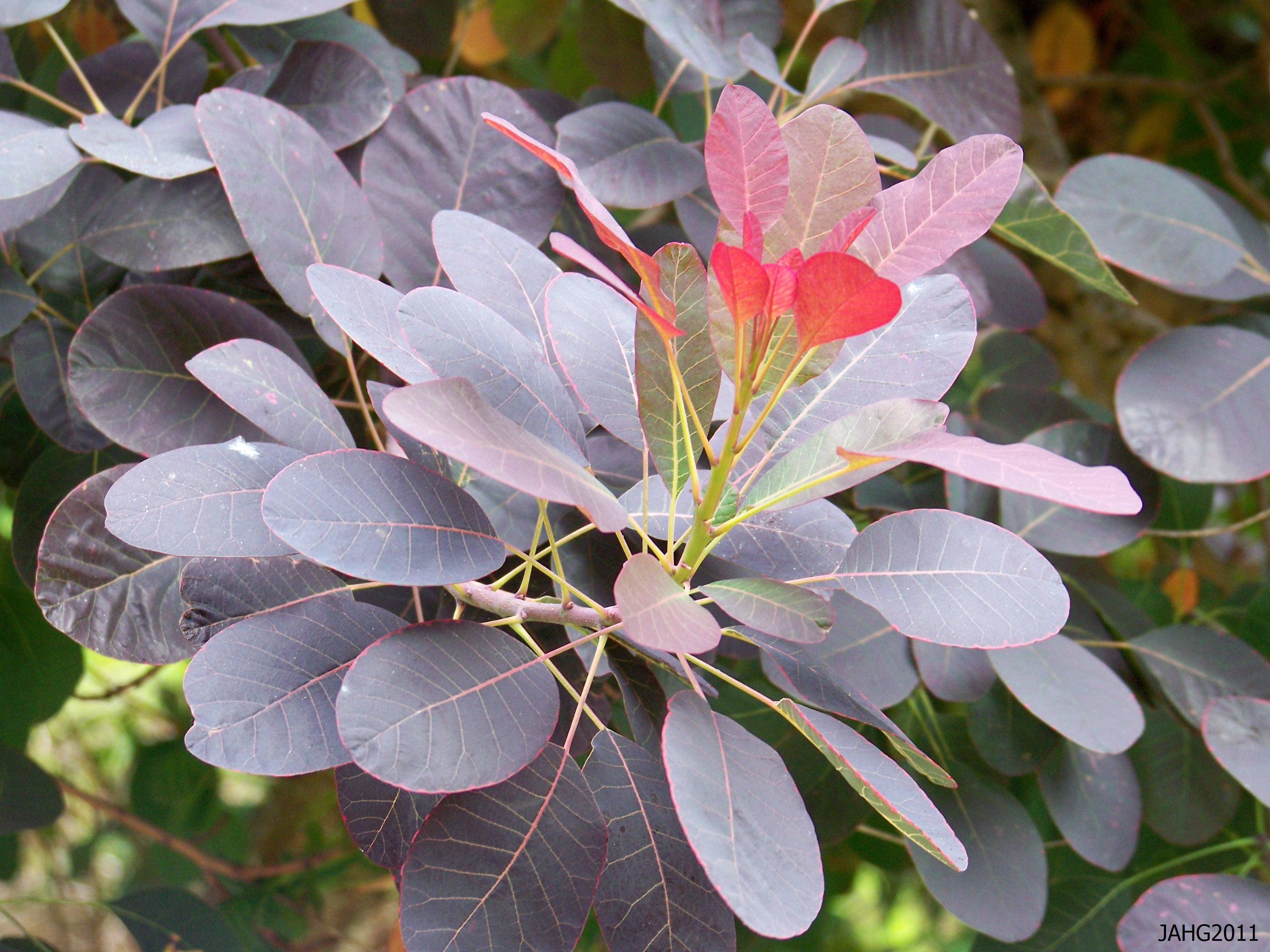
The color tones in one branch of Cotinus coggygria 'Velvet Cloak' is remarkable.
The genus Cotinus is a member of the family Anancardiaceae which also contains the Mango, Cashew, Poison Ivy (Sumac) species and was at first classified as Sumac(Rhus) species until it was separated from the other members. It does not irritate the skin or have sap which can burn.

Smoke Bush(Cotinus) generally have brilliant autumn colors ranging from scarlet into to peach and golds.
Cotinus is a small genus of 2 or possibly 4 species of which coggygria and obovatus are the best known. Cotinus coggygria is the species which is best known in the landscape and originates in Europe from France into Eurasia and possibly all the way into China. The far eastern representative coggygria sometimes listed as another species C. szechuanensis (var. szechuanensis). The other well known species is C. obovatus and comes from North America particularly in Tennessee, north Alabama, Missouri, Arkansas and isolated pockets in central Texas. All Cotinus species have been used extensively for a source of dye wood as it gives colors of orange-yellow and yellow coloring. The use of C. obovatus as a yellow dye source before the civil war in U.S.A. almost brought the species to extinction in its native habitats.

Cotinus 'Grace' is a cross between Cotinus coggygria 'Velvet Cloak' and C. obovatus.
Cotinus is from ‘Greek’ kotinos meaning wild olive but why it is named this is unknown. Coggygria also comes from ‘Greek’ kokkugia- the name of ‘Smoke Tree’. C.Coggygria has been cultivated in gardens for an unknown period but is first mentioned in the mid 17th century. The species form is not commonly seen in gardens as there are more exciting color forms.

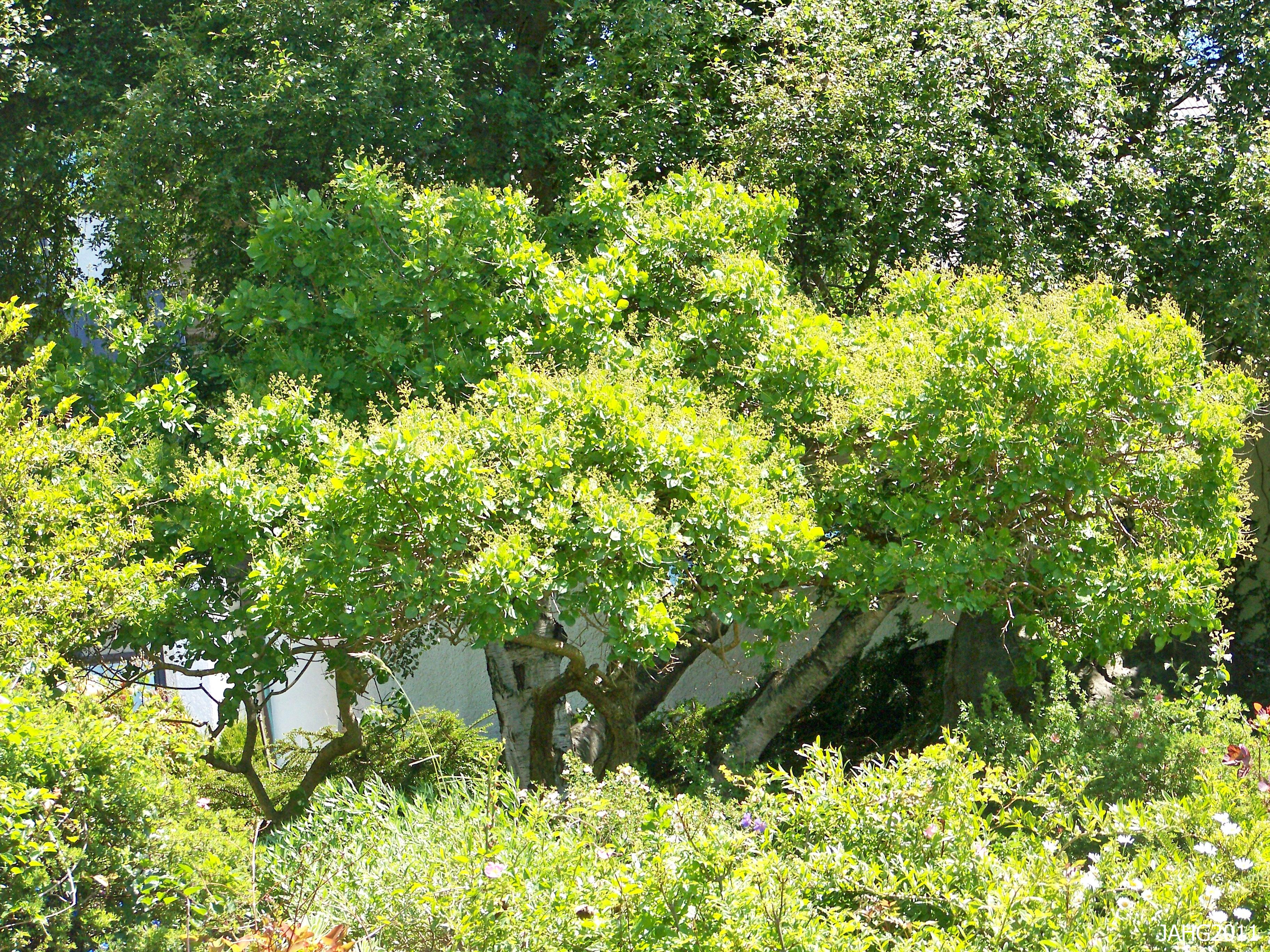
The less commonly seen species form of Cotinus coggygria is seen here with its lovely green foliage.
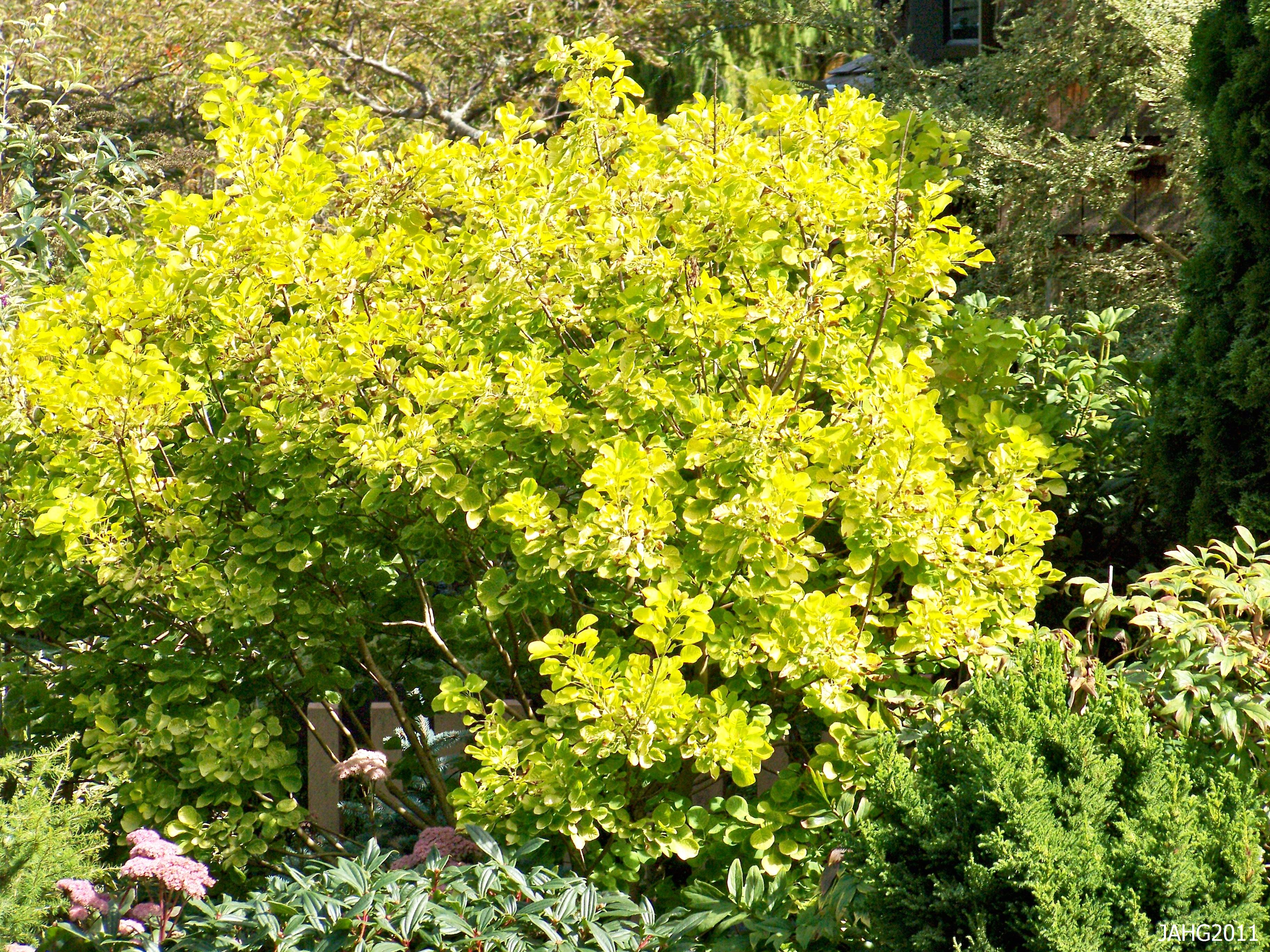
Smoke Bush are well known for their colorful foliage and there are an increasing number of cultivars to choose from. The oldest color form is probably C.c. ‘Foliis Purpureis'(Rubrifolius) which has rich purple -plum leaves which fade into to greenish tones as the summer progresses. C.c. f. purpureus(‘Atropurpureus’) refers to the coloring of the large panicles of purplish flowers. C.c. ‘Royal Purple’ (Notcutt’s Variety’) has leaves which start maroon red and then matures to black-purple(darkest of all forms) it holds its color well throughout the year and changes into scarlet autumn shades. C.c. ‘Velvet Cloak’ has red violet foliage which is dramatic, its floral display is longer than most. It holds is color well. Cotinus ‘Grace’ leaves emerge in wine-red and has clouds of pink-tinged flowers. A new color yellow range has come out from a chance seedling found at a dutch nursery in 1990, it is C.c. ‘Golden Spirit'(Ancot’) – it does not fade out unless it is under-watered.

The 'smoke in Smoke Bush or tree(Cotinus species) is from the panicles of tiny flowers and then the whispy seedheads later on.
All Cotinus species drier areas often with rocky soil on slopes and hillsides. They have proven to be vary adaptable to many other situations and soils from heavy clay to sandy. They need full sun pr produce the best coloring and floral display. They need adequate watering while becoming established but later are much more drought resistant. They are pest and disease free but sometimes coloring tends to fade out in hotter southern areas, this is where coppicing helps rejuvenate the color. The best coloring is obtained by regularly pruning them hard, use a method such as coppicing to produce wanted effect.

Cotinus 'Royal Purple'(the darkest color) is coppiced to keep its best color and form.
All Smoke Bush are rated at zones 5to 9 and take cold temperatures down to -28 c. (-20 f.) In colder climates they generally are cut to the ground which is like the mentioned coppicing. Cotinus can be used as specimens, in shrub borders, as accents, masses, in less watered areas and can pruned into tree forms which are very effective. Cotinus have a lot of appeal in the shape of the leaves and wispy flowers to add to a garden along with strong color.

Cotinus 'Golden Spirit'('Ancot') was found as a chance seedling at a Dutch nursery in 1990 and holds its color well in the September garden.
Cotinus in all its Glory:
Cotinus species : http://en.wikipedia.org/wiki/Cotinus
Cotinus obovatus, a web site devoted to it: http://cotinus.net/
Google image page of Cotinus coggygria cultivars, choose your color:
http://www.google.com/search?q=cotinus+coggygria+cultivars&hl=en&authuser=0&rls=com.microsoft:*:IE-SearchBox&rlz=1I7GGIE&biw=1920&bih=955&prmd=ivns&source=lnms&tbm=isch&ei=L5AHTuXmNYnViAKMl8zSDQ&sa=X&oi=mode_link&ct=mode&cd=2&ved=0CAsQ_AUoAQ
Why Coppice? http://apps.rhs.org.uk/advicesearch/profile.aspx?pid=121
Venetian
Posted in attractive bark, Butterfly Attracting plants, Colorful foliage, Drought Tolerant, Mass Plantings, Shrub/Tree, Specimens | Tagged autumn color, burgundy leaves, C.otinus coggygria 'Ancot', charteuse leaves, Cotinus 'Grace', Cotinus 'Notcutt's Variety', Cotinus 'Royal Purple', Cotinus coggygria, Cotinus coggygria 'Golden Spirit, Cotinus coggygria 'Velvet Cloak', Cotinus coggygria var. szechuanensis, Cotinus obovatus, Cotinus. szechuanensis, Cotinus.coggygria 'Foliis Purpureis, Cotinusa 'Grace', Edward Scissorhands, July blooming, June blooming, May blooming, plum colored leaves, purple leaves, red leaves, Smoke Bush, Venetian Sumac, wine colored leaves, yellow leaves | 1 Comment »
I was listening to the local radio yesterday as I went about my business about town, they were interviewing a local vegetable grower who said crops are 5 to 6 weeks behind where they normally are at this time of year. I knew the season was behind although it seems to me that plants catch up at different speeds and some never really seemed to have been effected by the bad weather here this year. One plant which just rolls along without a care is Erigeron karvinskianus Latin American Fleabane. It is rarely out of flower at any time of the year.

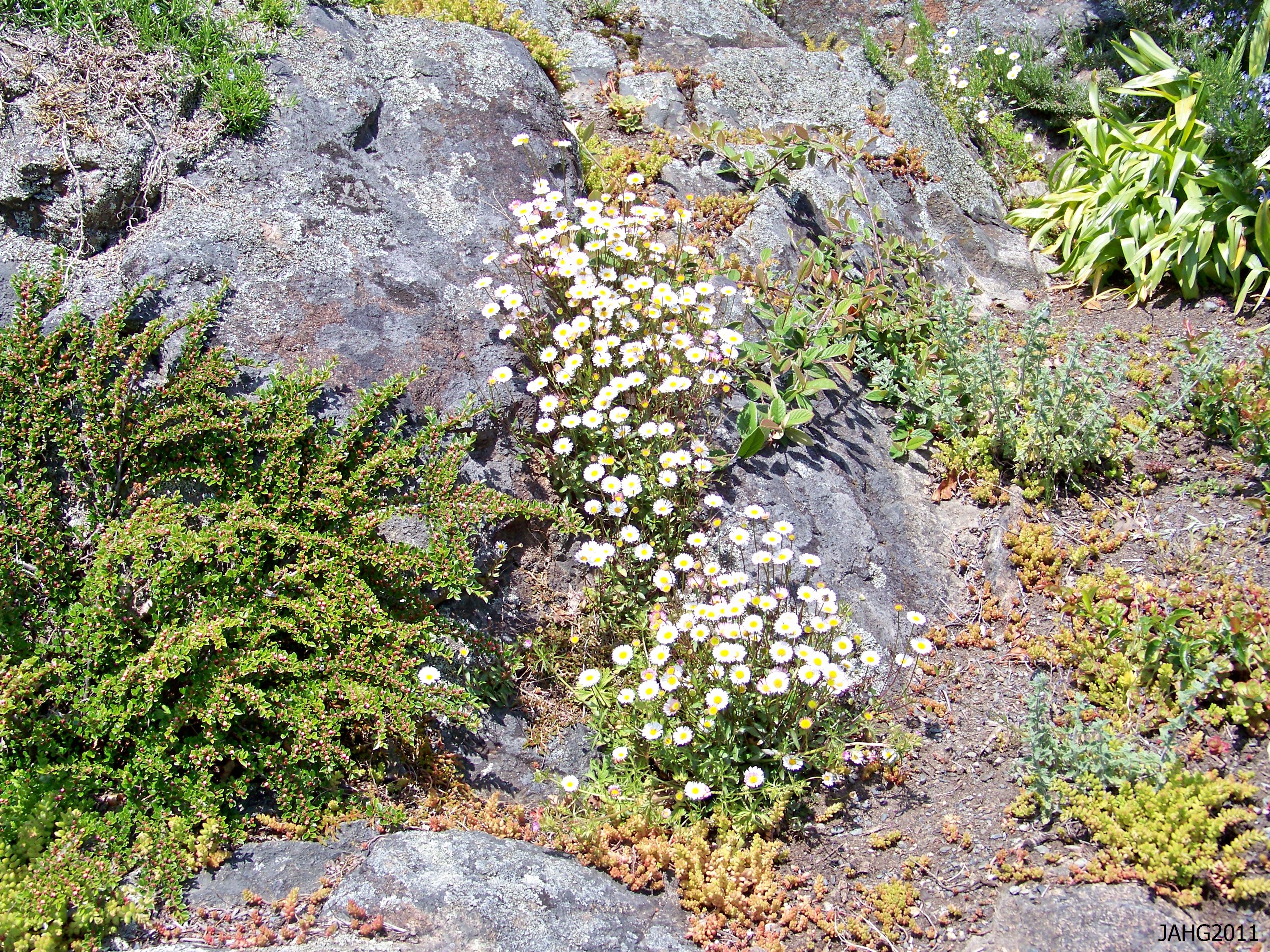
Erigeron karvinskianus (Latin American Fleabane) is a tiny sprawling plant perfect for containers,baskets and in rock cracks.
There are many Erigeron and most come from North America and as the common name tells you E. karvinskianus comes from more southern areas. It is found growing from Mexico south into Venezuela. In its native habitat it grows in the mountains at 1200-3500m (4000-11000 ft.) where is is evenly moist throughout the year. Spanish Daisy, Latin American Daisy, Santa Barbara Daisy or Mexican Daisy and even Bony Tip Fleabane – all are referring to the same plant.

With its tiny parts Erigeron karvinskianus does not seem out of place with other small plants here.
Erigeron isthought to be Greek eri=early and geron= old man. Karvinskianus refers to Baron Wilhelm Friedrich Karwinski von Karvin (von Karvin Karvinski) 1780-1855. He born in Hungary and was a naturalist with interests in Geology, Botany and particularly in the study of fossils from different periods. To this end he traveled to collect samples and the areas he went to was Brasil(1821-23) and Mexico(1827-32) . During his travels he sent back over 4000 plant specimens and several have been named after him, these include cactus, grasses and several others. He collected his sample of Erigeron karvinskianus while he was in Oaxaca Mexico.
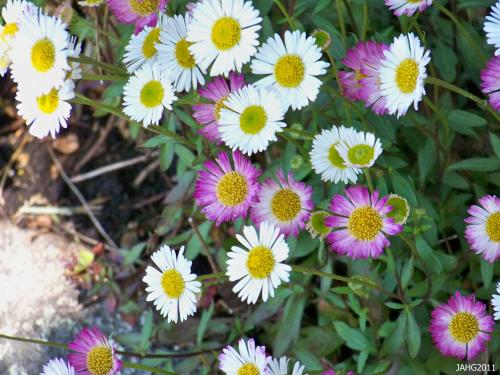
Part of the charm of South American Fleabane lies in flowers which open white and change into pink as they age. This effect is also seen in other Erigeron species.
Erigeron karvinskianus is a very successful plant since it has been grown at sea level and in some areas it has become somewhat of a pest. In Australia and particularly it is not welcome (in these areas it is recommended to plant Branchyscome multifida which is similar looking). The selection ‘Profusion’ refers to the flowers but also could well refer to its ability to reproduce quickly. In Victoria it is controlled by the climate being on the very edge of it being able to exist as a perennial here, many plant will have died this winter and new seedlings will take their place.

Here native Sedum, Cotoneasters and other mixed plants blend together in the rocks with Spanish Daisy to give a pleasing contrast in textures and color throughout the year.
I first came to know this plant as a grower at a perennial nursery and thought that this plant might be a good container plant as it has proved to be in other areas. It has mainly been grown for this purpose as it is not hardy enough for most of Canada. Here it can be grown as a short lived perennial which reseeds to refresh with new plants. Victoria and nearby areas are the only places you will see it growing in gardens as a regular plant.

The diminutive flowers on wiry stems of Erigeron karvinskianus are long lasting as they go through their metamorphosis from pure white to deep pink.
Erigeron karvinskianus like full sun and well drained soil which can be sandy or even having clay like it is around here. It like even moisture to slightly dry especially in colder areas as excess wetness promotes rot. These plants can be used in many ways, as fillers, accent,groundcover, massed, in large rockeries as long as its not near delicate growing or extremely small plants. They are fairly drought tolerant and attract butterflies to your garden. They are rated as zone 8 -10 c. (20-30 f.) They grow 15-20 cm high and wide.There are several named varieties, ‘Profusion’ is the best known and there is ‘Snowdrift’ which has white flowers. It is also thought that the species E. moerheimerii is just a form of karvinskianus and should be listed as E.k. ‘Moerheimii’
The Baron and the Little Flower:
Description of and cultivation for: http://www.perennials.com/seeplant.html?item=1.200.230
Fine Gardening has a good description: http://www.finegardening.com/plantguide/erigeron-karvinskianus-profusion-fleabane.aspx
Baron Wilhelm Friedrich Karwinski von Karvin: http://www.botanischestaatssammlung.de/DatabaseClients/BSMvplantscoll/About.html
…..Follow my trail to more interesting plant tails……..
Posted in Butterfly Attracting plants, Drought Tolerant, groundcovers, Mass Plantings, North American Plants, Ocean exposure Tolerant, Perennials, South American Plants | Tagged April blooming flowers, August blooming, August Blooming Flowers, August flowers, Baron Wilhelm Friedrich Karwinski von Karvin, Baron Wilhelm Friedrich von Karvin Karvinski, Bony Tip Fleabane, Erigeron, Erigeron karvinskianus, Erigeron karvinskianus 'Moerheimii', Erigeron karvinskianus 'Profusion', Erigeron karvinskianus 'Snowdrift', Erigeron moerheimii, Fleabane, Government House, July blooming, July Blooming Flowers, July flowers, June Blooming Flowers, June flowers, Latin American Daisy, March blooming, May Blooming Flowers, Mexican Daisy, October blooming, pink flowers, Santa Barbara Daisy, September blooming, September blooming flowers, September flowers, Spanish Daisy, white flowers | 2 Comments »
This time of the year usually is warmer and the Roses would be in full bloom, I guess I will have to wait a bit more. In the meantime I am reminded that there are so many other plants which are now stealing the show and some of them do it in a way which is more subtle than just big wonderful blooms. Often we overlook fantastic foliage which accompanies the flowers. How about this novel idea, a plant which the foliage is just as much the star if not more, a tall order I would say! One plant I and many other gardeners would nominate is Achillea ‘Moonshine’ (Moonshine Yarrow).

Achillea 'Moonshine is part of the street plantings in Brentwood Bay and looks good year round, tidy foliage and bright non-fading flowers.
Achillea ‘Moonshine’ comes from the famous plantsman Alan Bloom(1906-2005) and Bressingham Gardens. If you look through perennial plant books you will see the name Alan Bloom and Bressingham Gardens mentions many times. Alan Bloom came from a plant family, his father grew cut flowers and fruit for a living . Alan left school to go into the business, his wise father said he should try as many areas as possible to find where his interest were and he settled on hardy perennials. After working as an apprentice Alan started his first wholesale perennial nursery in Oakington, the place of his birth. It took only 4 years for Blooms nursery to become the biggest of its kind in England. In 1946 he purchased the Bressingham Hall (near Diss in Norfolk) which included 228 acres of land. He began developing it during the 1950s and early 60s, during this time he also introduced nearly 200 newly named plant selections and hybrids which originated from his nursery and the famous gardens.

The golden flowers and silver foliage of Achillea "Moonshine" is bright and soft at the same time making it an easy plant to work into garden designs.
‘Moonshine’ Yarrow is a cross between A. clypeolata (silvery foliage ,strong chrome yellow flowers) and taygetea( ferny foliage and creamy yellow flowers). It was discovered as a seedling around 1950 and introduced into gardens about 1954. It was quickly recognized to be an outstanding plant and was awarded an A.G.M.(Award of Garden Merit) from the Royal Horticultural Society. The plant has proved to be one of the best ‘Blooms’ introductions and is seen in many situations from well maintained gardens to the tough street side planting.

The silvery foliage of Achillea 'Moonshine combines the delicate 'ferniness' of A.taygetea with the silver sturdiness of A. clypeolata.
I first encountered Achillea ‘Moonshine’ a the wholesale perennial nursery I worked at in the early 1990s and I knew at once that this was a great plant compared to the other Yarrows which were grown there at the time. The foliage was beautiful by its self and the slightly creamy yellow flowers seemed to bloom for the longest time. These plant were always quickly bought up by the local nurseries, landscape architects and designers who put in orders or came to visit the nursery to see the plant stock we had there.

Here Achillea 'Moonshine' is used as a way to hide unsightly Rose stems along the exterior of the Rose Garden at Government House in Victoria.
Achillea ‘Moonshine’ is an easy to grow plant which tolerate a good amount of neglect which makes it a very versatile plant for use in many situations. It does require full sun to produce the silveriest foliage and the most golden flowers, but, this is little to ask for such a grand reward! It takes most kinds of soil as long as its well-drained as wet feet can lead to trouble for most Achilleas. It is a fairly compact plant growing 60 cm.(2 ft.) high by about the same wide. Keeping it slightly under-watered will keep the floral stems from sprawling.Cut it back after its first flowering for it to repeat later in the summer. Divide it every couple of years to keep it vigorous.

Achillea 'Moonshine' is excellent as cut or dried flowers and will continue to give pleasure long after other flowers are spent.
Achillea ‘Moonshine’ is hardy to -30 c.(-20 f.) and takes wet climates well as long as the soil is well drained. In the hotter areas it is said that the plant melts out in full sun conditions but I can find no explanation as to what this means. I might assume it is better to give it richer soil(moisture retaining) in those areas. Use this plant in any hot border, such as that with Lavender and Sages. Let the yellows and purples play together with the silver foliage to create a classic color combination.It works as an accent, specimen, in borders or containers and massed. It attracts butterflies to your garden during the summer. An added bonus is it is both deer and rabbit resistant and drought proof.

These "Moonshine' Yarrow have been cut back and are now coming into their second bloom of the summer.
Mining For Moonshine:
Good advise for growing you own ‘Moonshine’ http://www.perennials.com/seeplant.html?item=1.010.500
Alan Bloom: http://en.wikipedia.org/wiki/Alan_Bloom_(plantsman)
Bressingham Gardens are worth a visit if you travel to England:
http://www.bloomsofbressinghamplants.com/about-us/the-perennial-tradition/the-bressingham-gardens.html
Other people comment about there experiences with this plant: http://davesgarden.com/guides/pf/go/48885/
…………I hope you mine some gems here and come back soon…………
Posted in Butterfly Attracting plants, Colorful foliage, Cut Flowers., Drought Tolerant, Mass Plantings, Ocean exposure Tolerant, Perennials, Specimens | Tagged Achillea 'Moonshine', Alan Bloom, August blooming, August flowers, Blooms of Bressingham, Brentwood Bay, Bressingham Gardens, fragrant flowers, Government House, grey foliage, Grey leaves, July blooming, July flowers, June blooming, June flowers, May Blooming Flowers, Moonshine Achillea, Moonshine Yarrow, silver foliage, siver leaves, sulphur flowers, yellow flowers | 3 Comments »
As a child I spent many days in the woods near our house in town and at the lake, there my interest in plants was awakened. Many of the plants I encountered there I have not found in the area I live now. Other plants I see may be related to the forms I grew up with. One plant I learned as a child but find different species of here is Thalictrum. In the woods I saw Thalictrum occidentale and its leaves in particular being so delicate remained in my memory. Here we are blessed with several species of this plant with the best known probably being Thalictrum aquilegifolium (Common Meadow Rue). It has the beautifully dainty foliage but completely different and unusual flowers and the bonus is that it is very hardy.

A perfectly growing Thalictrum aqilegifolium 'album' is seen at Beacon Hill Park in Victoria.
Common Meadow Rue has a fairly wide area which it is found growing wild in. It ranges from west in France and Spain in through Switzerland into western Russia south into Romania into Bulgaria and rarely found in Turkey. With the area it is found in it is not surprising to note that several well known varieties have been collected.

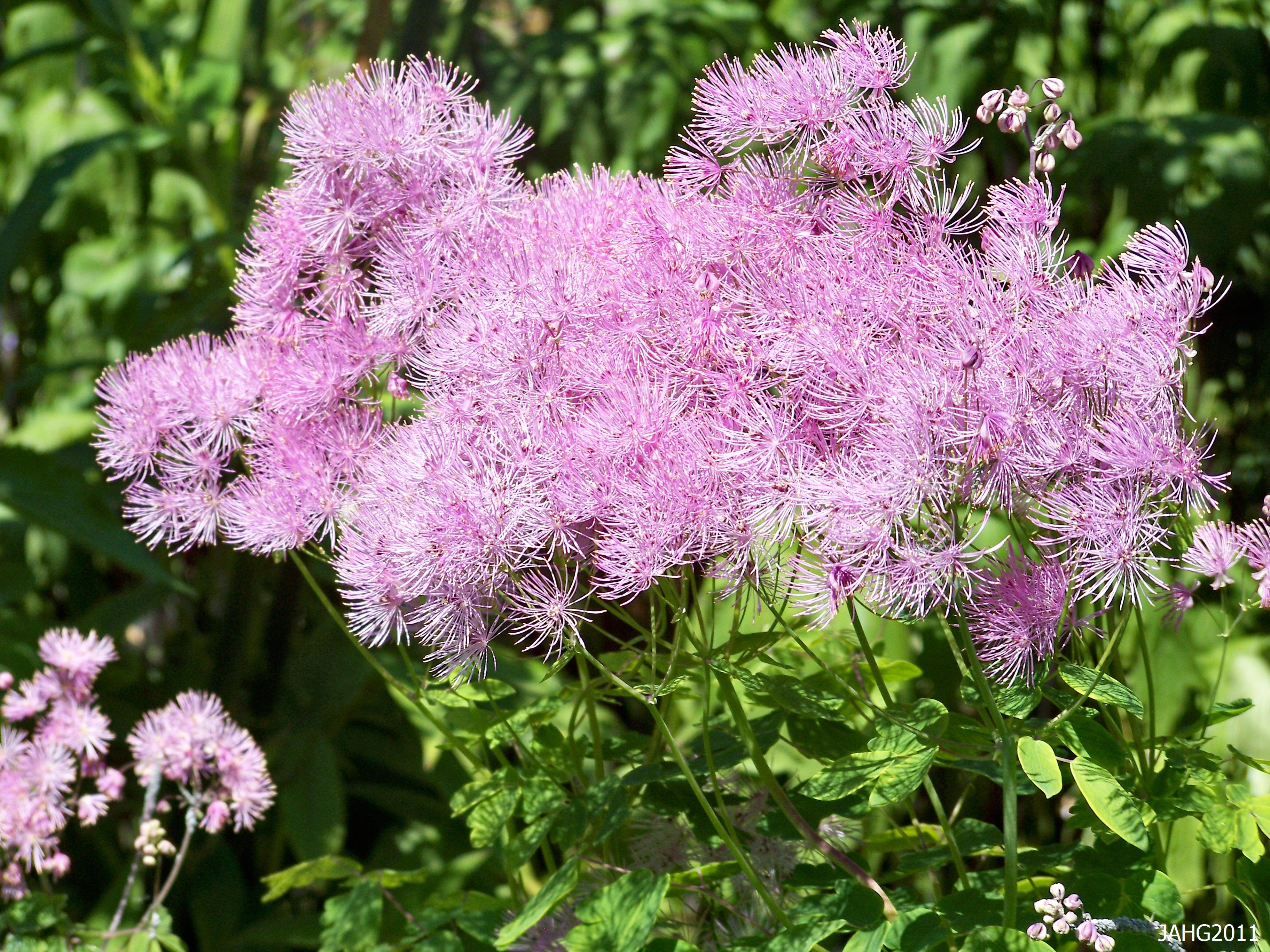
Thalictrum aquilegifolium color ranges from deeper and lighter mave shades, pale pink , cream and pure white.
In researching Common Meadow Rue there is surprising little written about it. The plant was named by Linnaeus and is thought to be the original Greek name. The genus of Thalictrum is quite large with between 100 and 2oo named species. It has proven to be difficult to define its taxonomy. Over time these problems will disappear which a closer look at genetic material now being used to determine and classify plants.

Thalictrum aquilegifolium grows well in the sun or shade with suitable soil conditions met.
Thalictrum aquilegifolium is a fairly large plant in that it grows quite tall and for this reason is best place in the middle or the back of the bed. Generally Common Meadow Rue grows 1-1.2 m. (3-4 ft.) tall and spreads 30 cm. (1ft.). It is densely grown and if grown in enough sun does not need staking as the floral stems will be rigid They like humus rich soil which retains moisture during the summer but is not wet. They like dappled to full sun, the more sun the more watering needed to look their best. They are easy care and have attractive seed heads.

The delicate foliage of Common Meadow Rue is perfectly matched by its downy,fluffy flower heads.
With its sturdy growth and yet dainty grace Thalictrum aquilegifolium is tough and withstands prairie cold temperatures of -35c. (-31 f.) and is rated as zone 3. I can attest to its hardiness as I gave one of these plants to my mother (zone 3) who promptly planted it in her garden. The following year I visited as was greeted with a glorious show of mauve flowers on a sturdy plant. In the following years my mother told me how much she enjoyed the plant and that it has produced several seedlings which she planned to move to other locations in the garden. Seed is the best way to propagate the plant, remember to stratify (chill it like it would go through winter). These plants can be divided in autumn when they are dormant.

Here Common Meadow Rue is planted mid-range in a sunny long border at Playfair Park in Saanich.
Mauve or White..
A prairie gardens comments on the plant: http://em.ca/garden/per_thalictrum_aquilegifolium1.html
Comments from gardeners from around the world and their experiences: http://davesgarden.com/guides/pf/go/501/
An interesting tracking of the popularity of this plant over the years in graph form:
http://www.newcrops.uq.edu.au/listing/species_pages_T/Thalictrum_aquilegifolium.htm
………I hope you continue to make tracks to visit here weekly………..
Posted in Butterfly Attracting plants, Colorful foliage, Cut Flowers., Mass Plantings, Perennials, Specimens | Tagged April blooming flowers, attractive seed heads, attractive seedheads, attrative foliage, Common Meadow Rue, delicate leaves, fern-like foliage, fern-like leaves, interesting foliage, Mauve Flowers, May Blooming Flowers, pink flowers, purple flowers, Thalictrum aqilegifolium 'album', Thalictrum aquilegifolium, white flowers | 2 Comments »
This week the America Iris Society is having its national convention here in Victoria. All the important public gardens have been prepared in the last year for the event by planting out beds of many species, hybrids and cultivars in them. With the cooler than normal spring that has effected this area of the continent most of the plants are behind their bloom schedule. One of the important species is looking lovely non the less and has some blooms. I am referring to Iris pallida and in particular the variegated forms of Iris pallida ‘Argentea Variegata’ and I.p. ‘Variegata’ (Variegated Sweet Iris).

Iris pallida Argentea Variegata has a lovely creamy quality which is a standout in any garden.
Iris pallida comes from the Dalmatian Coast (former Yugoslavia) into northern Greece and up into northern Italy. It is sometimes called the Dalmatian Iris for this reason The plant is fairly variable in flower color ranging from dark purple, lighter purple into pink and white. With the color variablity there are also several subspecies (ssp.). I.p. ssp. pallida has pale lavender flowers originates in western former Yugoslavia where it grows on the limestone cliffs there. I.p. ssp. cengialtii has darker purple flowers with white or orange tipped beard and greener leaves and is found in north-east Italy. Iris pallida ssp. illyrica is sometimes classed as a separate species (Iris illyrica) and the issue at this point is unresolved. It has mid purple flowers and is found in its namesake, ancient Illyrica (northern Dalmatian coast). I.p. ssp. pseudopallida comes from the southern Dalmatian coast. There is another subspecies that is known as I.p. ssp. musulmanica which I can not find any information about.

Iris pallida has unmistakable grape scented blossoms which delights and excites the nose and is reminds many of us of our youth.
I worked for many years in the wholesale area of horticulture and during that time was able to observe many plants over a long time in different conditions. Variegated Sweet Iris was imported into Canada by the perennial grower I worked for and I could compare it to many other Iris species, cultivars and hybrids at the time. Not only was I.p. ‘Argentea Variegata’ brought in but the golden variegated (‘Aureo Variegata’) form was brought in. It was clear at that time that I.p. ‘Argentea Variegata’ was the better form, is stronger growing an is less prone to disease in the wet winters we have here. This may be the reason that I.p. ‘Aureo Variegata’ is not seen and probably not sold in this area any more.

The foliage of the Variegated Sweet Iris is distinct and beautiful
There is another variegated Sweet Iris which is often mixed up with Iris pallida ‘Argentea Variegata’ and it is I.pallida ‘ Variegata’. It is hard to tell them apart at a glance but Iris pallida ‘Variegata’ is much whiter and does not get the creamy- buttery tones in its leaves. It is also said that it is more vigorous but I can not say this is true as I have not seen the plant growing over a period of time to say for sure.I feel it is likely these plants are much mixed up in trade and often mis-labeled for each other.

This I believe is Iris pallida 'Variegata', as you can see there is no real buttery coloring in the foliage. Note all the pictures in this article were taken on the same day in one garden.
We are fortunate that Iris pallida ‘Argentea Variegata’ is much easier to obtain today and is an easy plant to grow in our gardens. It needs a bright location with full sun to part shade to bring out its best qualities. As with all rhizome producing Iris it is important to plant them very shallowly. It likes very good drainage with humus rich soil, this is particularly important if you live in areas of high humidity or have to deal with wet winter like we have here. Good air circulation is a good idea as this will help dispel any fungus which might be lurking about. You will see signs of fungus with leaf spotting and greyish discoloration along the blade edges. Keeping the area clean and removing spent leaves is also important for the same reason. Plant rhizomes should be divided every 3-4 years to thin the plants out and renew soil.
- These Iris pallida ‘Argentea Variegata’ (Sweet Variegated Iris) were planted for the American Iris Society convention which is be held in Victoria this year.
Iris pallida and its forms are reliably hardy to zone 5 or -23 c. (-2o f.) and I have read that they can be pushed to even colder zones if they are well protected. These plants grow 60 cm. (24 in.) high and about 30 cm. (12 in.) wide. Variegated Sweet Iris are specimen plants which do not need competition in the garden so keep other plants at a distance to show them off. They definitely can be used as an accent and make the most impact mass planted. They can also be used in containers and are most often seen in perennial borders.
Finding your Variegated iris:
American Iris Society: http://www.irises.org/
Where does this species come from: http://en.wikipedia.org/wiki/Illyria
Iris pallida is an ancient plant but not much is written about it: http://en.wikipedia.org/wiki/Iris_pallida
……I hope you will be reading what I write again….soon…..
Posted in Colorful foliage, Cut Flowers., Drought Tolerant, groundcovers, Mass Plantings, Perennials, Specimens | Tagged American Iris Society, attractive foliage, Cut Flowers., cut foliage, fragrant flowers, Government House, grape scented flowers, grape scented Iris, I.p. 'Variegata', I.p. Argentea Variegata, Iris pallida, Iris pallida 'Argentea Variegata', lavender flowers, Mauve Flowers, May Blooming Flowers, purple flowers, purple Iris, variegated Iris, Variegated Leaves, Variegated Sweet Iris | 3 Comments »
2 days of bright sun light and everyone is out mowing their lawns, the garden centers a full of shoppers buying plants, then back into the grey. It has been grey and dreary almost everyday this year! It is not surprising at all that we rush out into the rare spots of sun and then slump around the rest of the time in a mental fog. Is it no wonder that brightly colored flowers appeal to us so much, at this point any garish and screaming color at all is welcome. One of the brightest groups of plants that bloom at this time are the deciduous Azaleas which come in the purest oranges,tangerines, golds and yellows. Rhododendron luteum (Pontic Azalea) says it all in its name – I have brilliant yellow flowers and I am here to seduce you out of your fog with my fragrance.

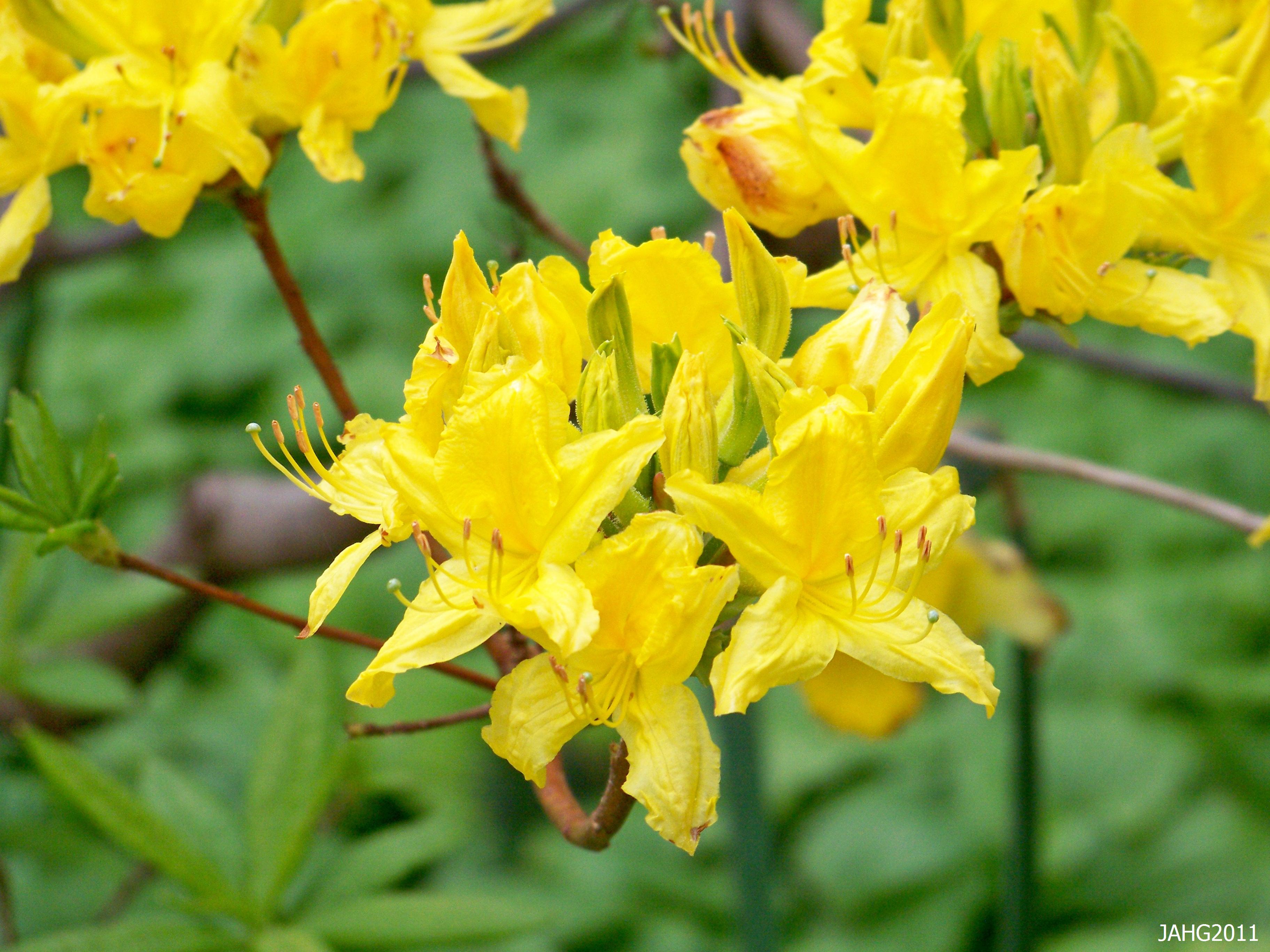
Rhododendron luteum has brilliant flowers which have a wonderfully sweet fragrance
Here most people associate Rhododendrons with the evergreen types and do not realize that the Azaleas are actually Rhododendrons as well. The ‘so-called’ Azaleas often are seen to be a poor plants you see in mass plantings used to landscape large shopping centers, townhouse complexes and other institutions and are often poorly maintained. Rhododendron luteum represents the deciduous Azaleas most often found in parks and often have the reputation of ‘smelling skunky’. Pontic Azalea does not have the ‘skunkiness’, people often wonder were the wonderful scent is coming from and find out it’s from that yellow Azalea!
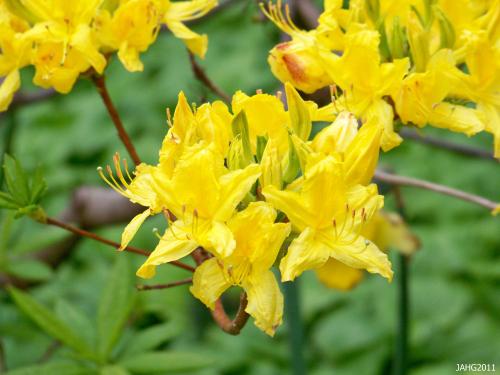
The elusive fragrance of the Rhododendron lutuem flowers entrance the bees and our noses, but be wary as the pollen and honey is poisonous.
Pontic Azalea is a fairly wide-spread plant and is found in Poland, Austria through the Balkans, Southern Russia running into the Caucasus into the southern tip of the Black Sea, an area once called Pontus. The first reference to Rhododendron luteum comes from Pliny and Doiscorides ( circa 40-90 AD) who refered to the works of Xenophon(430-354 BC). Xenophon participated and chronicled the conflict between Cyrus the younger(and gardener) and his older brother who would become Artaxerxes II. They went to war and Cyrus died and his army retreated to the Pontus Hills near the Black Sea. The plan was to collect supplies there and escape by sea back to Greece. While the troops where there the ate the locally collected honey which came from the Azaleas which grew there. The army became ill and seemed drugged. This mystery of what happened was blamed by Dioscorides on the Pontic Azlaeas and the honey which was consumed there.

As Rhododendron luteum is often grown from seed there is some variation in the flowers such as the vibrancy of coloring and width of the petals.
Many centuries later French botanist Joseph Pitton de Tournefort(1656-1708) travelled to examine the geography of the area as he was studying Dioscorides. There he wrote a description of and did a drawing the Pontic Azalea which he named Chamaebodobendron Pontica Maxima flore lutea, this was just the first of the names this plant has been given.

The bright yellow color of the Pontic Azalea is pleasing and blends well in many plant combinations.
Rhododendron luteum went through several name changes until in the 1830s it was decided to give it the name it is known by now. Most recently the claim to fame by the Pontic Azalea is that it is an important contributor to hybridization of Azaleas in creating a wide range of pleasing colors for the softest pastels into most vibrant colors. Pontic Azaleas are particularly associated with the Ghent group of hybrids which were developed in Belgium over 150 years ago. More than 100 were named and at least 25 are still available to buy now. The other use for Pontic Azaleas is for a understock to graft weaker growing forms onto.

This small Pontic Azalea is part of the extensive Rhododendron collection at Glendale Gardens.
Rhododendron luteum is an easy and adaptable plant to grow. It likes dappled light and rich, slightly acidic moisture retentive soil which does not dry out completely in droughts. This helps promote a larger number of blooms the following year. Good air circulation is important to help ward off any chance of mildews or fungus which can develop later in the season. Established plants do not need fertilizer but appreciate a light mulch of pine needles or other acidic material applied every year. Do major pruning as soon as the plant has finished blooming to avoid cutting of next years blossoms.

Playfair Park has several areas with Pontic Azaleas included in the gardens.
Rhododendron luteum grows 3-4 m(9-12 ft.) tall and is narrower in width. It is not densely branches and is light and airy in the garden. In autumn it give another show of red and yellow foliage colors. It can be used as a specimen or accent and as a mass planting. It is a good plant for a woodland or wilder setting or can be used in more formal locations. It is said to take -15 c. (5 f.) which makes it one of the more hardy deciduous Azaleas available.
Some Azalea Madness for you:
A good technical description of the plant: http://www.rosebay.org/chapterweb/speclut.htm
Toxicity of Rhododendrons: http://rhodyman.net/rarhodytox.html
A Pdf file from Arnold Arboretum on Ghent Azaleas http://arnoldia.arboretum.harvard.edu/pdf/articles/1355.pdf
Xenophon, Greek historian, soldier and mercenary: http://en.wikipedia.org/wiki/Xenophon
How this Rhododendron almost stopped an army http://www.atlanticrhodo.org/kiosk/features/misc/luteum.html
…..Will you follow my trails through the plant world?……
Posted in Butterfly Attracting plants, Colorful foliage, Historic Plants, Mass Plantings, Shrub/Tree, Specimens | Tagged April blooming flowers, autumn color, Beacon Hill Park, colorful foliage, Doiscorides, Finnerty Gardens, fragrant flowers, Glendale Gardens, Joseph Pitton de Tournefort, May Blooming Flowers, Playfair Park, Pontic Azalea, Rhododendron luteum, Xenophon, yellow flowering shrubs, yellow flowers | 2 Comments »
When I moved to go to school I soon missed the outdoors in the way I had experienced it during my life. I was no longer able step outside and wander in the woods within a few steps of the home I had lived in. It was not until I moved to the island I am on now that I had time to find the wild again as it was much closer. Now I wander in the woods and along paths where wildflowers and nature is close to undisturbed. People here care a great deal about keeping it that way. I have had the chance to become re-aquainted to some plants which were beloved by our family here. The Maianthemum family offer up 2 of these loved plants and 1 other which is new to me. I a particularly fond of Maianthemum dilatatum( Wild Lily of the Valley)

Maianthemum dilatatum (Wild Lily of the Valley) is now is the same botanical family as the real Lily of the Valley(Convillaria majalis).
Maianthemum family has recently gone through several changes which are important to note: first it has expanded to include the species which were once known as Smilacina. The other more important thing is that Maianthemum species was moved from the Lilacae (Lily)family into the Ruscaceae family which includes Convillaria(Lily of the Valley) now. It shows the close relation of Maianthemum and Convillaria. This realignment is quite interesting botanically as it changes what we used to think of as Lilies(Lileaceae).

As a child I would pick armloads of Maianthemum racemosum (Smilacina) and give them to my mother to put in vases at home.
Around here you will most like come across Maianthemum dilatatum in the moister areas of the woodlands. I first came across it along the path that ran next to the house I lived in for many years. Not far away I found it growing with horsetail under the Rhododendron plantings at Dominion Brook Park, the contrast in textures was interesting. I was delighted to find it on my first visit to Finnerty Gardens where it is used as a lush groundcover. I now see it in many places which are shady and somewhat damp throughout the year.

This bright Rhododendron luteum is set of by the lush Maianthemum dilatatum covering the ground so completely at Finnerty Gardens.
The similarity of False Lily of theValley to Convillaria is somewhat hard to find as the leaves are so broad and the flowers are not bell-shaped. Both plants are highly fragrant and all parts are poisonous to consume in any form. Mainathemum dilatatum is found in a large area running from Northern California along the coast through Alaska on to the Russian coast south into Korea and finally into Japan. Maianthemum was named by Linnaeus most likely after M. canadense which was already known from samples collected in eastern North America.

The leaves of Wild Lily of the Valley (Maianthemum dilatatum) remind me very much of that of some Hosta cultivars with their overall shape and vein pattern of the leaves.
There are other members of the Maianthemum family which are more refined, the already mentioned M. canadense is a charming smaller version of dilatatum. Maianthemum stellatum grows here and was originally classed as a Smilacina which is seen in its foliage. It has few flowers and is delicate, I first came across it near Playfair Park at the top of Judge Place growing along a seep area.

Maianthemum stellatum is a delicate colonizing plant found in the woodland across northern areas on North America.
All the Maianthemum species I have mentioned here can be vigorous spreading plants and care must be taken when placing them in your garden so they do not overwhelm other weaker plants. The most agressive of these plants is M. dilatatum which creeps into gardens and provides a seemingly smothering coat of leaves. These plants grow by creeping rhizomes(roots) which are able to branch and spread more widely. They all like rich moisture retentive soil which does not dry out completely during hot periods. These plants prefer dappled to fairly deep shade and will go prematurely dormant if they are too exposed to overly bright, dry situations.

Wild(False) Lily of the Valley (Maianthemum dilatatum) provides a strong and lush groundcover.
Maianthemum racemosum, stellatum and canadense are extremely hardy plants and take zone 3-8 (-40 c and f.). Maianthemum dilatatum tolerates probably -20 c (-4 f.). M.racemosum grows to 1-1.25 m.(4 ft.) tall and easily as wide. The other species will grow no higher than 35 cm.(15 in.) tall and an indeterminant width. M. canadense is the smallest and least vigorous growing plant and could be used in more delicate places. All these plants are highly fragrant, have good autumn coloring and make good cut flowers. All these plants fit into the woodland garden and can be used for groundcover, massing or as accents. Maianthemum racemosum is a standout plant with attractive foliage, berries and golden autumn coloring which makes it an excellent specimen for a shady garden.
Maianthemum madness:
Pacific Bulb Society listing of species: http://www.pacificbulbsociety.org/pbswiki/index.php/Maianthemum
Wiki listing of all the species http://en.wikipedia.org/wiki/Maianthemum
PNW Flowers listing of M.dilatatum: http://www.pnwflowers.com/flower/maianthemum-dilatatum
Posted in colorful berries, Colorful foliage, Cut Flowers., groundcovers, Mass Plantings, native plants, North American Plants, Perennials, Specimens, West Coast native Plants | Tagged April blooming flowers, colorful berries, cream flowers, Dominion Brook Park, Finnerty Gardens, fragrant flowers, groundcovers, Maianthemum canadense, Maianthemum dilatatum, Maianthemum racemosum, Maianthemum stellatum, May Blooming Flowers, Playfair Park, Smilacina, Smilacina racemosum, West Coast native Plants, white flowers, Wild Lily of the Valley | 2 Comments »
Older Posts »


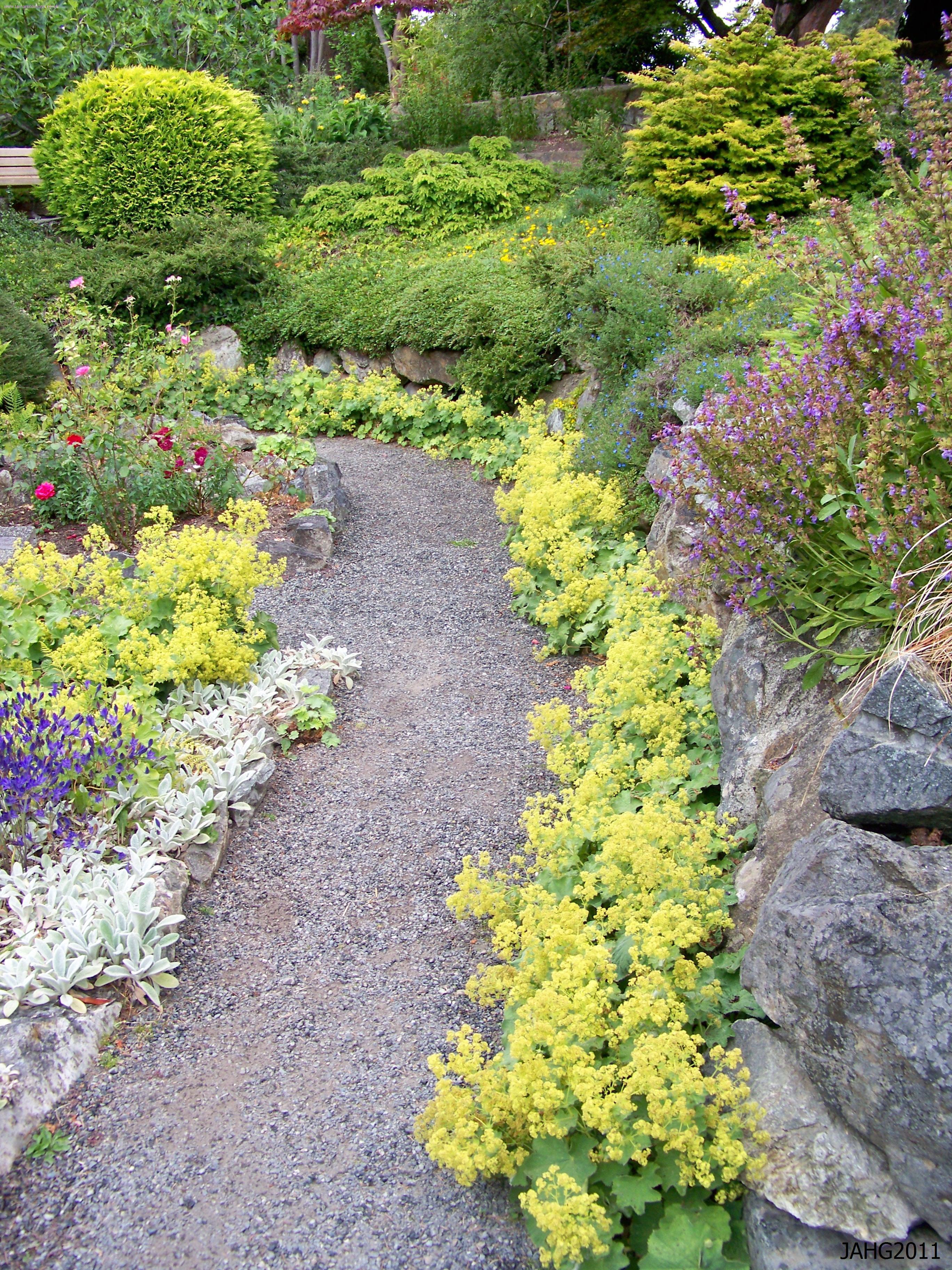


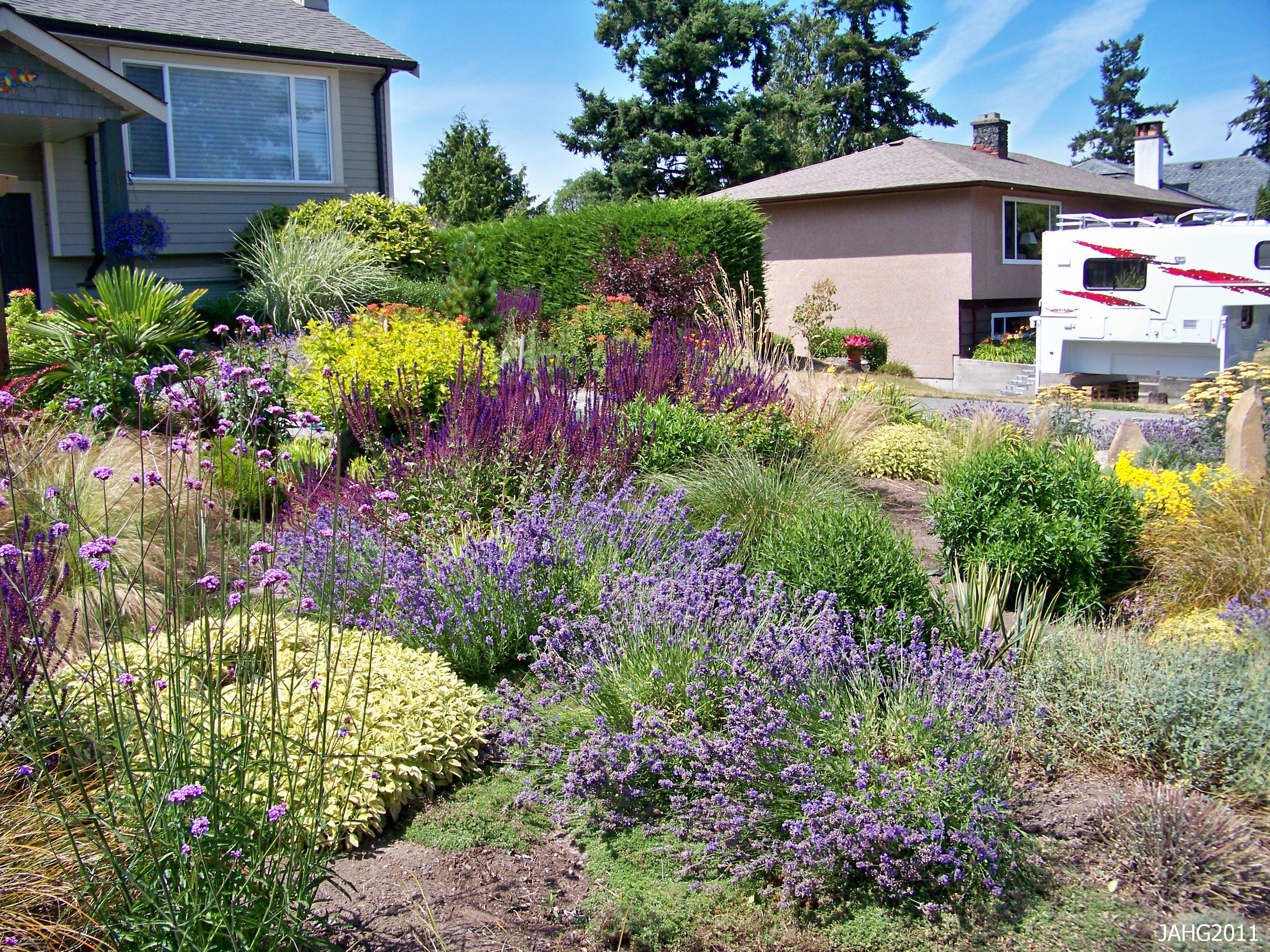














 Stumble It!


![[Get Copyright Permissions]](https://i0.wp.com/license.icopyright.net/images/icopy-w.gif) Click here for copyright permissions!
Click here for copyright permissions!

 Name That Plant